Devolution
Under devolution, rural businesses and communities may finally get the recognition and priority they deserve
Devolution and how powers are transferred from central government to strategic authorities is a major policy objective of the current administration. Devolution will have a significant impact on rural communities and it is important that CLA members and other rural businesses are well informed.
To better understand how devolution can impact you, explore the following resources in this comprehensive online hub:
Calling for government action
Devolution is a complex issue that involves a shift in the balance between central and local government, alongside the reorganisation of local authorities. For devolution to succeed, ministers must ensure the right structures are put in place, rural interests are taken into account and local voices are heard.
In the report below, the All Party Parliamentary Group (APPG) on the Rural Powerhouse has made 21 recommendations that underline the need for a better balance between rural and urban priorities. These include a statutory duty to consider the needs of the countryside in policymaking, the creation of business boards to strengthen links between strategic authorities and local enterprises, the appointment of dedicated rural commissioners and mandatory impact assessments.
For more details on what the government's Devolution Act actually means for land managers and rural Britain as a whole, you can also listen to our devolution-focused 15 Minutes With... podcast below.
If you want more information on devolution and how it will impact your business, please contact Dr Charles Trotman.
1. Understanding devolution
Devolution means taking away certain powers from central government (Whitehall) and giving these to England’s regions. The current government, under Prime Minister Andy Burnham, has made devolution a priority. To support this, the English Devolution and Community Empowerment Act gained Royal Assent in April 2026.
The CLA has produced a simple guide to devolution to explain the finer details. This summary sets out the objectives of devolution, its different stages, the roles and responsibilities of strategic and unitary authorities, and the changes to local decision making.
The CLA has also been working with Britain’s Leading Edge (BLE), a coalition of local authorities with significant rural hinterlands. In July 2026, we led a webinar on devolution with BLE, aimed at increasing members’ understanding and making the case why the government’s devolution ambitions need to fully reflect rural need.
Discover more
Watch our webinar to learn how devolution could affect you2. The CLA’s six devolution missions
Devolution covers a number of different policy areas where strategic authorities will receive increased powers. These are known as areas of competence and the CLA has produced six devolution missions that cover these subjects.
Select one of our six devolution missions below to read for yourself:




3. Devolution and policy making
Under devolution, new decision making structures are being created, such as mayoral strategic authorities, and county councils are being transformed into unitary authorities, as part of the largest reorganisation of local government since 1972.
This means looking at policy making in a different way, through a different lens. One of the main recommendations of the APPG report on devolution and its impact on the countryside is the creation of economic boards to help advise rural commissioners. This would act as a 'bridge' between strategic authorities and rural businesses which would prevent policy vacuums and unintended consequences.
4. Statutory areas of competence
During the passage of the English Devolution and Community Empowerment Act 2026 through Parliament, substantial lobbying took place to include 'rural affairs' as an area of competence. Originally, there were seven competences and every attempt to include rural affairs were rejected.
However, under pressure from peers in the House of Lords, rural affairs and coastal communities finally became an area of competence. With culture added, the act now sets out nine areas of statutory competence:
- Transport and local infrastructure
- Skills and employment support
- Housing and strategic planning
- Economic development and regeneration
- Environment and climate change
- Health, wellbeing and public service reform
- Public safety
- Culture
- Rural affairs and coastal communities
But inclusion in the legislation is only the first step. For rural affairs to become an effective area of statutory competence, it must be supported by practical policy mechanisms, including rural proofing, that ensure policies reflect the needs and circumstances of countryside communities. This means that rural interests, such as on skills or transport, must be taken into account at the inception of policy.
All too often in the past, government departments have paid lip service to the impact policies have on rural areas and interests. With rural affairs now a statutory area of competence, central government has an opportunity to provide devolved authorities with clear guidance on how rural needs should be considered when developing and implementing policy. The CLA is a member of the Defra/MHCLG advisory group putting together this guidance.
5. Devolution and the skills agenda
The UK Government has given strategic authorities the powers to set policies on skills as well as creating the frameworks needed to provide a skilled workforce. However, one of the problems CLA members and other rural employers face is a lack of engagement. This means they feel cut off from decision making that shapes the skills agenda.
We believe the strategic authorities have a unique opportunity to put in place a skills agenda that can practically meet the needs of rural businesses. To make this work, skills policy must be developed in partnership with employers to promote effective apprenticeship schemes and act as an engine for economic growth.
It seems remarkable that there has been so little attention given to alternative labour pools and the skills these may be able to give employers. There are perception issues – for example, businesses are unlikely to employ ex-offenders. This can also be applied to the military veterans community as there is a failure of employers to be able to recognise the unique skills sets on offer.
Over the least three years, the CLA has been developing the Veterans Initiative, a key part of which is the Veterans Rural Skills Partnership. This is a network of veterans and rural organisations that want to assist military leavers in finding suitable employment as well as meeting the business needs of CLA members.
Listen below for more details on the Veterans Initiative.
6. Planning and housing within mayoral strategic authorities
It's well known that the current planning system is not fit for purpose. The planning system prevents rural economic growth and there is clear evidence that plans to invest in rural businesses are being abandoned through a lack of faith in local planning authorities.
However, devolution can help unlock the planning system. The CLA has responded to the government’s proposals on creating planning powers for mayors in England. These seek to introduce powers to allow mayors to call in planning applications of a certain kind, establish Mayoral Development Orders and introduce a Mayoral Community Infrastructure Levy (CIL).
Whilst we are supportive of many of the proposals, as planning functions are further devolved, they must work for rural landowners and businesses. We do object to the introduction of a mayoral CIL.
Although the aim of devolution is to bring power into the hands of local communities, in terms of planning, local decision-making needs to be supported by a strong national framework. The guidance must do two things: a) support members where local NIMBYism is restricting their ability to develop, and b) support communities with ambitions to develop.
There is also a risk with devolution that resource within local authority planning teams becomes less localised, and more focused on delivering large housing sites and infrastructure projects. There needs to be a strong suite of permitted development rights to lessen the resource strain on local authorities, de-risk development for landowning businesses and give greater flexibility to those wishing to develop. These permitted development rights not only cover housing but also building for commercial, tourism and agriculture.
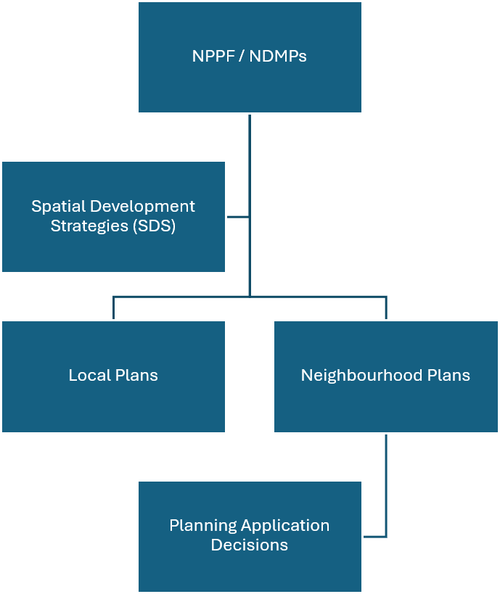
The rural exception site planning passport is a long-standing CLA objective, and similar to Permitted Development Rights (PDRs), will de-risk, reduce costs and resources and increase the delivery of rural affordable housing. This will be particularly important in devolution as large housing targets across a strategic authority will take focus away from small rural sites.
Larger strategic authorities may have more options to meet housing targets without building on the green belt. The CLA’s green belt asks should therefore be included in national policy before devolution expands further.
There is a concern that strategic authorities will have very large housing targets and will inevitably de-prioritise smaller rural sites. We are lobbying for local targets for rural housing delivery. If a strategic authority needs to deliver 100,000 homes, the rural target would set out how many of these, or what percentage, need to be delivered on small sites, including in settlements of less than 3,000 inhabitants.
7. Devolution mapping and engagement
It's important to understand that the devolution agenda is set in a series of stages and varies throughout England. There are those mayoral strategic authorities that are already in place (such as North Yorkshire and the West of England Combined Authority), those that will be holding future mayoral elections and those that are still to take the first steps on the road to devolution.
What this means is that the CLA has to engage both with Strategic Authorities as well as a range of external stakeholders. We are already part of a number of networks that provide advice and guidance to local authorities. However, these need to be extended to ensure that property and business rights for members are protected without leaving rural communities behind.