Your complete guide to applying for SFI 2026
Everything you need to know about eligibility, submission windows, actions, payments and key considerations before considering your application for the 2026 Sustainable Farming Incentive
Defra has now released the near-final version of the scheme rules and guidance for the Sustainable Farming Incentive 2026 (SFI26) scheme. It is expected there will be a revised version released shortly with minor changes (i.e. to tighten definitions and correct any referencing errors). Alongside the scheme rules and guidance, Defra has also released the terms and conditions and published the full list of actions.
For farmers and land managers who are considering whether to apply, the we have completed a series of four articles which set out the context of SFI within the Environment Land Management (ELM) schemes, outlined practical readiness steps, provided an outline of the actions and payments, and considered delivery requirements. These can be found here:
1. Understanding ELM schemes: where does SFI fit?
2. Getting ready for SFI 2026: how landowners can prepare now
3. What SFI offers and how to decide what's right for your business
4. SFI 2026: Delivery, requirements and what happens in practice
Defra has already started a series of 13 free workshops across the country – providing the latest farming updates, including more information on SFI.
The CLA will also be running a free webinar on Tuesday 16 June, for both members and non-members, featuring a representative from Defra who will discuss the SFI26 scheme in detail. Follow the button below to register your place.
To help you plan ahead, read our summary of the key information below.
The SFI budget
Defra has now released information on the SFI26 budget. It has confirmed that window one will have a budget of £60m and window two will have a budget of £180m (with a total budget for SFI26 of £240m). The CLA understands that any underspend from window one, i.e. if the full £60m is not allocated, will be transferred over to the total budget for window.
"This SFI budget announcement is welcome, but the funding may not stretch far enough,” said CLA Deputy President Joe Evans in response to the news. “A £240m budget is unlikely to meet expected demand.”
“It is particularly important that farmers with agreements ending later this year are able to transition seamlessly into new agreements. With funding capped and application windows limited, there is a risk that some businesses will miss out, creating uncertainty at a crucial time.
“Defra must now ensure the application process runs smoothly and provide regular, transparent updates on the budget.”
If demand proves stronger than anticipated, ministers should be prepared to review the budget to avoid leaving viable applicants without access to the scheme
What to consider for SFI26 window one – opening late June
Window one is expected to open on 30 June for registered holdings with between 3-50 ha of agricultural land, and/or those without a current ELM revenue agreement.
Eligibility
Eligibility for the first window requires a farm business that:
- Was registered with the Rural Payments Agency (RPA), so it had an Single Business Identifier (SBI) by 1 January 2026, and the SBI had some agricultural land linked to it on that date.
- Qualifies as either a small farm (being under 50 hectares), or a farm without an existing Environmental Land Management (ELM) revenue agreement.
Further definitions around the eligibility requirements of both the applicant and land can be found in section three and five of the scheme guidance.
Controlled rollout
Defra has confirmed that there will be a controlled rollout for the first window of SFI. A small number of farmers will be contacted and invited to be part of a limited number of early applications (around 18 June). The intention is to ensure that the application system functions correctly, and any system errors can be resolved before the official window opening.
Support for small farms
Defra has released a leaflet to help applicants prepare for SFI26. This considers steps to cover before application, the purpose of SFI26, as well as outlining some popular actions for arable, mixed and grazing farms to consider. The leaflet can be downloaded here and Defra has also released a map which shows the most popular SFI26 actions chosen by farms up to 50 hectares in each region.
What do we know about window two for SFI26?
Aside from the common eligibility requirements for both windows one and two under SFI26, which we have outlined below and can be found in full here, the only additional application eligibility requirement that Defra has outlined for window two is that “your farm business needs to be registered with the RPA (so it has an SBI) at the point you want to start an application.”
What this entails is that, where a farm business has been restructured since 1 January 2026, or a new farming business has been created, they will not be able to access window one. However, the timings outlined mean the farming business would be able to access the SFI when the second window opens.
It is still anticipated that the second window will open in September 2026, however, there has been no commitment to a specific date, and the possibility of delay remains open.
Other eligibility points to be aware of for both windows
Common land
At this time, SFI26 remains closed for common land applications due to the inability for the IT system to process these applications. The CLA have, along with other national stakeholders, co-signed a letter to Defra ministers urging them to seek resolution to this issue impacting several CLA members.
Minimum area requirement
For both windows one and two, SFI26 applicants must have registered at least three hectares of agricultural land. While this precludes any applicant with less than three hectares registered with the RPA, this does not mean that eligible applicants are required to enter more than three hectares of land into an SFI26 scheme.
Management control
For entry into an SFI26 scheme, applicants must have management control of the parcels of land entered for the duration of the agreement term. Typically, this will either mean an applicant is an owner-occupier or a tenant under either a Farm Business Tenancy or Agricultural Holdings Act tenancy. Section six of the scheme rules and guidance provides further information on management control and who is eligible to apply for SFI26.
Land with historic or archaeological features
It is possible to enter land into SFI26 where there are historical or archaeological features present, however, applicants must ensure they consider the specific action guidance. These features include scheduled monuments, non-designated or archaeological features, registered parks and gardens, and registered battlefields. Where SFI actions are compatible for land with historic or archaeological features, it will be necessary to get an SFI Historic Environment Farm Environment Record (HEFER) from Historic England before undertaking the affected SFI action.
On the other hand, if land with historic or archaeological features is ineligible for a certain SFI action, “this only affects the area where the feature is located in a land parcel. You can apply for the SFI action on the remaining area in the land parcel if it’s eligible for the action”.
The CLA has written a guidance note on how designated and non-designated historic features affect agri-environment schemes, which members can access here.
Sites of Special Scientific Interest (SSSIs)
If the SFI action is compatible with SSSIs, then it is necessary to get consent from Natural England before the action is completed. Further details on how this can be done is found in the SFI scheme rules and guidance.
Choosing appropriate SFI actions
Defra has released the full list of SFI26 actions, which can be downloaded either as a print version or seen through the SFI grant finder tool. The grant finder tool is worth investigating as it allows applicants to review actions falling into specific land types (such as scrub or arable) and areas of interest (such as agroforestry or pollinators).
There are 71 actions available in SFI26. Of these, 70 are actions which were available in previous schemes and there is one new action, GRH12: manage rough grassland for upland breeding waders. This is a replacement of GRH1: manage rough grazing for birds that was available in the SFI24 scheme.
Some actions have had changes to the requirements and payment rates, and therefore we urge applicants to ensure they fully review the most recent guidance.
Defra has provided an outline of what changes have been made to SFI24 actions. For example, for CAHL4: 4m to 12m grass buffer strip on arable and horticultural land, the print version appears as follows:
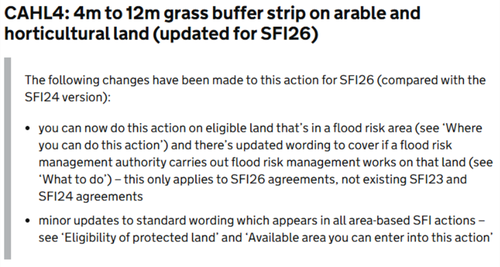
Each action guidance will then provide the duration, payment rates, aim of the action, where the action can be performed, eligible land, and other practical implications such as when, where, and how the action should be done.
There are 10 limited area SFI26 actions whereby the action can only be done on up to 25% of the farm area. These are:
- CIPM2: Flower-rich grass margins, blocks, or in-field strips (IPM2 in the SFI 2023 offer)
- CAHL1: Pollen and nectar flower mix (AHL1 in the SFI 2023 offer)
- CAHL2: Winter bird food on arable and horticultural land (AHL2 in the SFI 2023 offer)
- CAHL3: Grassy field corners or blocks (AHL3 in the SFI 2023 offer)
- CIGL1: Take improved grassland field corners or blocks out of management (IGL1 in the SFI 2023 offer)
- CIGL2: Winter bird food on improved grassland (IGL2 in the SFI 2023 offer)
- WBD3: In-field grass strips
- AHW7: Enhanced overwinter stubble
- AHW9: Unharvested cereal headland
- AHW11: Cultivated areas for arable plants
If you wish to consider using any of these actions in your SFI26 application, Defra has provided a limited area action calculator. As the 25% limit is applied across all SFI agreements an applicant may have, this tool can be a useful way to ensure that applications are not inadvertently breach the SFI26 conditions.
The action guidelines have been published as a near-final version. It is expected there will be a revised version released with minor clarifications. We urge applicants to always review the final guidance before submission.
CLA analysis
Before applications to either window one or two, it’s vital that you begin preparations on your land for entry into the schemes. There are practical steps that you can take which are outlined here as well as through the Defra Farming Blog.
The CLA is aware that there remains a concern among several applicants about the sequencing of the SFI window two along with expiring Countryside Stewardship Mid-Tier schemes and SFI23 agreements from September 2026 onwards. We continue to work with Defra and the Rural Payment Agency to seek a resolution to this.
The SFI is just one option among a suite of other ELM schemes and productivity grants that members can consider. If you ever need advice tailored to your business on this or other rural matters, please do get in touch with your local CLA team.
Please remember to join our free webinar on Tuesday 16 June to have your questions answered by CLA and Defra experts.