CLA Political Breakfast opens Devon County Show
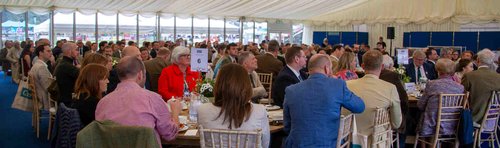
The Country Land and Business Association kicked off Devon County Show with its annual Political Breakfast at Devon County Show.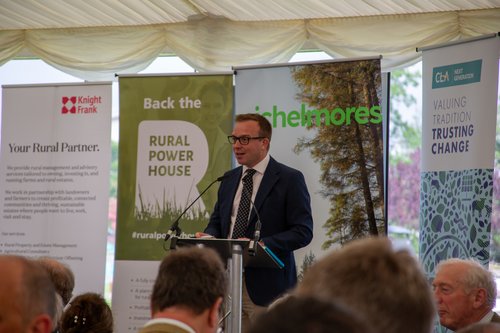
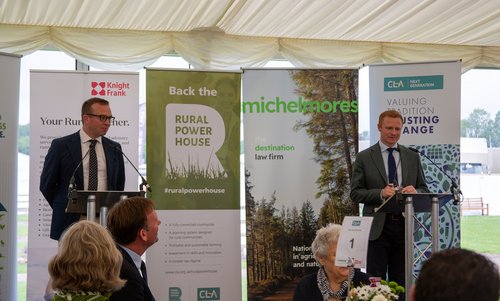
The event was attended by 220 farmers, landowners and rural business owners from across the region, who gathered to hear from CLA Deputy President Joe Evans and guest speaker Robbie Moore MP, Shadow Minister for Environment, Food and Rural Affairs.
Speech given by CLA Deputy President Joe Evans.
I feel it's my job to try and start the show on a positive note, and that's what I'm intending to do. It's clear that we are facing no shortage of headwinds. The long-form version of my remarks would be a fascinating and detailed discussion on our work on land use framework, planning reform, the farm profitability review, local nature recovery strategies, energy efficiency, and our relationship with the EU.
But I'm not sure you'd thank me for monopolising your entire morning going into all of that. So I'm going to limit my remarks to a comment on food security, a comment on SFI, and a reflection on where we are with inheritance tax. War in the Ukraine and in the Middle East, alongside a rising protectionist agenda around the world, has rightly pushed food security to the top of the national agenda. And the challenges faced by our primary producers this year are acute. Whilst livestock and dairy prices have been holding up, there are many of us still recovering from a brutally dry summer and lack of forage last year. Certainly my case with my beef and sheep farm in Herefordshire. And arable farmers are facing punishing input costs. And many other businesses are stuck in limbo in between agri-environment schemes.
Now, in that context, it would be relatively easy and, dare I say, popular for me to stand up here and advocate for direct subsidies for farmers in these times. But in truth, most of what we produce enters global commodity markets, and simply putting more money into the bank accounts of farmers will not necessarily change the price or the availability of food on supermarket shelves. But what does matter is that our government creates the conditions for resilient farming businesses to succeed. And on this score, I do think our current government has made some serious mistakes. After inheriting some difficult budgetary realities that Robbie may refer to in his remarks, this government utterly bungled the communication surrounding the sudden halt to SFI last year, and in one fell swoop that significantly damaged industry confidence.
Furthermore, in recent roundtables with DEFRA, I detect that there is still a lack of clarity from ministers about what they really and truly want the agricultural budget to achieve.
The cap on SFI, as an example, reveals an ideological problem within government about farmers accessing public money efficiently and at scale. Thank goodness we were in the room for the final stages of that scheme design, otherwise the cap would have been significantly lower. And Mary would shout at me if I didn't mention the uplands. SFI remains inadequate in the uplands. In Dartmoor and Exmoor there's real frustration, and uncertainty with threats surrounding de-stocking, and a feeling that environmental delivery is now outweighing the act of farming itself. All battles that we continue to fight on your behalf.
One other little anecdote I wanted to share with you. I was recently at a policy meeting on higher tier development, which hopefully will be an important part of the future for uplands here in Devon. At this policy meeting, these DEFRA officials kept referring to us as customers. As customers, we've got to make sure we do right by the customers.
I couldn't help myself. I had to very politely interrupt and say, no Defra, we're not customers of the government. We are suppliers of the government. A stable, sustainable farming incentive scheme has the capacity to be world-leading. It could create a genuinely new relationship between the state and us farmers. One that's based on partnership and not on dependency. A stable scheme would give farmers confidence to invest. Invest in fertile soils, secure water supplies, better habitat, healthier livestock, crop diversity, and thus create long-term resilience. And I don't think many farmers would quarrel with those ambitions.
But of course, we're competing in a global market, and many other producers prioritise short-term output. Increasingly behind the scenes, our supermarket customers understand that investing in resilient farming systems makes good commercial sense in the long term. But of course, they too are constrained by global competition and shareholder pressure. And only in the last few days, some slightly bonkers ministerial pressure around supermarket shelf price capping. Food security for me, ultimately, means giving farmers confidence. Confidence to invest, confidence in stable markets, confidence that trade policy will not undercut British standards, confidence that skilled labour and plentiful water will be available. And incidentally, on water, I very much hope that we'll shortly be able to announce some interesting developments on permitted development rights for on-farm reservoirs.
Briefly on inheritance tax, and I know I did talk to you a bit about this exactly 12 months ago from this platform. I'm really looking forward to hearing from Robbie who I'm sure will once again confirm to me to us all as he did to me a few weeks ago that the Conservative government intends to reverse changes to APR and BPR a promise that's also been made by the Reform Party I have to confess the Green Party are a work in progress but my feelings on the issue despite 12 months going on my feelings on the issue are no less strong than when I addressed you last year I was deeply moved at this very show, meeting members who found themselves directly in the crosshairs of the proposed changes. And the increased threshold to two and a half million is of course welcome for the many members, many farmers who find themselves now outside. But fundamentally, a tax on business assets runs counter to everything that this government claims to support. It's anti-growth, it's anti-risk taking, and it's anti-farming. And for me, even worse than the direct financial impact.
It's the sentiment it creates, a sentiment that I hear on my tour around the country that we all start to feel that this government is somehow against us, against the very businesses that it depends on.
Now, I must level with you, I do not detect the conditions for further concessions from this government. It feels like backbenchers have moved on, but of course, politics is moving quickly and who knows what the government will choose to bring into the debate, but we will continue to make the economic case. My real concern is that if economic growth remains sluggish, there may be a temptation to look once again at broader forms of capital or asset taxation.
And the last thing I want to do is set hairs running. I have no inside track. This is a personal view. But I think it was amplified, as I said, when I checked the BBC News app at 5 o'clock this morning when West Streeting announced he was going to run on a wealth tax. It's going to be really important for me that this Labour leadership contest doesn't become a contest to see which candidate can tax us the most. Any form of land tax would be catastrophic for our sector. I do hope that our work on inheritance tax, the over 8,000 pieces of media coverage that we had, the remarkable public outpouring of support, I think that will give the Treasury pause for thought before they come after us again. But we do have to be mindful that it's likely to be on the agenda. And I suspect much of the work that I will be doing and the team will be doing in the coming months will be ensuring that the conditions for running our rural businesses don't get even more difficult. I do recognise that it's quite a tough sell. The CLA is here to ensure things don't get any worse is not the most inspiring slogans but to some extent I do feel that a lot of our work is going to be about making sure we don't go backwards.
I promised I'd try and leave on a positive note and despite all of these headwinds I do remain optimistic because the truth is this sector has weathered even more hostile political environments over the past century, and we're still here. Society increasingly understands the value of what land-based businesses can provide.
We grow food, we store water, we provide beauty, we manage the landscapes that people turn to for health, inspiration, and recovery. And forgive me, Robbie, but for all of the political noise, for all of the political noise, it's farmers, it's land managers, not Whitehall, who will ultimately provide the space for nature recovery, climate resilience, green energy, housing, and will do all of that whilst at the same time growing food.
At a time when AI is disrupting so much of society and commerce, my confidence in the future of rural England, and Devon in particular, grows only stronger. Because when the country needs long-term thinking, stewardship and resilience, it still turns to the countryside.
Despite all of the headwinds I remain optimistic because the truth is this sector has weathered even more hostile political environments over the past century, and we're still here. Society increasingly understands the value of what land-based businesses can provide.