What could CBAM mean for farmers and fertiliser costs?
The UK’s new Carbon Border Adjustment Mechanism (CBAM) could influence fertiliser prices from 2027. We explain what it means and offer five practical steps that farmers can take to prepare
The UK's Carbon Border Adjustment Mechanism (CBAM) is due to come into force on 1 January 2027. The policy will apply a carbon price to certain goods imported into the UK, with the aim of ensuring overseas producers face a comparable carbon cost to UK manufacturers.
The information on CBAM is still being released by the UK Government and the current policy summary from HM Revenue & Customs (HMRC) can be found here.
Why is CBAM being introduced?
CBAM is being introduced to address the risk of "carbon leakage". This occurs when production shifts to countries with lower environmental costs, potentially reducing emissions in one country while increasing them elsewhere. By applying a carbon-related charge to imports, the government hopes to create a more level playing field concerning emissions produced between UK producers and overseas competitors.
The initial scheme will cover goods from five sectors: aluminium, cement, fertiliser, hydrogen and iron and steel. While most farmers and land managers are unlikely to be directly liable for CBAM administration, the policy may well influence the cost of some products used by agricultural businesses.
Why could CBAM matter for agriculture?
For many farming businesses, fertiliser is likely to be the most relevant CBAM product.
Fertiliser production can be highly energy-intensive and is associated with significant greenhouse gas emissions, particularly in the manufacture of nitrogen fertilisers. As a result, fertilisers have been included within the initial UK CBAM scheme. The comparable EU CBAM scheme, which took effect on 1 January 2026, covered the same five sectors.
Most farms purchase fertiliser through UK suppliers rather than importing it directly. As a result, most land managers and CLA members are unlikely to be responsible for reporting or paying a CBAM liability themselves. However, importers and suppliers may seek to reflect both CBAM liabilities and associated administration costs in the prices charged further down the supply chain.
This does not necessarily mean fertiliser prices will increase by the exact amount of any CBAM charge. On top of any potential CBAM charge, input costs will continue to be influenced (both positively and negatively) by several factors, including energy prices, global supply and demand, and wider market conditions.
Who will have to pay CBAM?
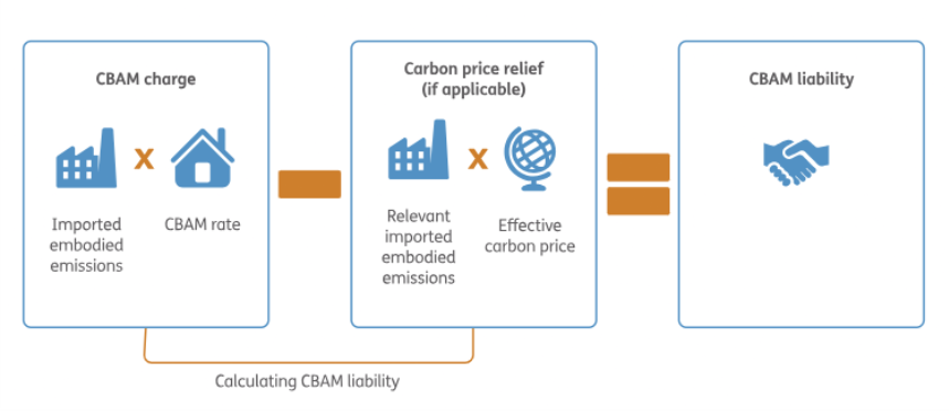
In most cases, the liability will fall on the importer of the goods entering the UK. The amount payable will broadly depend on the emissions associated with producing the imported product and the applicable UK carbon pricing arrangements.
Businesses importing covered products above the government registration threshold will need to register with HMRC and submit CBAM returns. A person must register when they meet the minimum CBAM threshold, which has been set at the following levels:
- Forward looking test: if the liable person expects to import over £50,000 of a CBAM good over the next 30 days, they will be liable to register.
- Backward looking test: if the liable person met or exceeded £50,000 worth of imports over the previous 12 months, they will be liable to register.
Certain exceptions apply, including some non-business imports and goods imported under temporary admission arrangements.
Some imported goods may qualify for Carbon Price Relief where an equivalent carbon price has already been paid in the country where the product was manufactured. Certain requirements are in place to ensure that these costs are reviewed by an accredited and independent verifier, as well as considerations taken where the country of production provides offsets on carbon payments or other relevant compensation. Carbon Price Relief can reduce the final CBAM liability, although the CBAM liability will never drop below £0.
Further guidance can be found on the government website here. The below image, provided by Gov.uk, provides an overview of the CBAM liability calculation:
What could this mean for fertiliser prices?
At present, it is too early to predict precisely how CBAM will affect fertiliser prices.
The government has published indicative CBAM rates for different sectors and indications are that charges will initially be relatively modest. For fertilisers, HMRC has published an indicative rate of £1.45 per tonne of carbon dioxide equivalent emissions. However, official charges for CBAM (once the accounting period commences on 1 January) will be calculated using the latest available data and published at the start of each quarter.
An illustrative calculation of the CBAM rate for the concrete sector can be found here.
For most farm businesses, the more important question is not the border charge itself but how much of that cost is ultimately passed through the supply chain.
Farmers should also be aware that the final CBAM liability is unlikely to remain static. The government has indicated that the support currently available to some UK industries through free carbon allowances is expected to reduce over time. Additionally, a reduction factor has been introduced to reflect the gradual withdrawal of free allowances. For the CBAM scheme year 2027, this is set at 97.5%.
CBAM liability is therefore likely to increase, potentially strengthening the impact on future import costs.
For this reason, land managers and CLA members should avoid assessing CBAM solely on the basis of its introductory rate. The longer-term implications could be more significant than the initial figures suggest.
Could diesel and other fuels be included in future?
The government launched a consultation on expanding CBAM to include refinery products on 28 October. The CLA understands that the consultation covers the feasibility and potential impact of including products such as petrol, white and red diesel, and jet fuel within the mechanism.
Refinery products are not part of the five sectors entering CBAM from the start of 2027. The consultation closes on 20 January 2027 and outlines that the government’s intention is “to include a subset of refinery products in CBAM as soon as it is feasible, subject to consideration of responses to this consultation on the feasibility and impacts of doing so and will set out a timeline in due course."
The potential implications will depend on which products and commodity codes are ultimately included, the timing of any expanded scope and how costs are transmitted through the fuel supply chain.
You can review the government consultation on expanding CBAM to refinery products and submit your own response if you wish. The consultation closes at 11.59pm on 20 January 2027 and can be found here.
What can farmers do now?
For many land managers, immediate action will be limited, but there are several sensible preparatory steps:
- Establish whether the business imports any goods directly. Those importing fertiliser, steel products, cement, aluminium or other potentially covered goods should determine who acts as the importer of record.
- Speak to fertiliser suppliers. You may wish to ask suppliers how they are preparing for CBAM and how any liability is likely to be reflected in quotations and contracts.
- Ask for clarity when comparing prices. Quotations should make clear whether any expected CBAM cost is included, excluded or subject to later adjustment. As outlined, the CBAM charge will take effect from 1 January 2027, with the first accounting period running from 1 January 2027 to 31 December 2027. The first returns and payments will be due five months after the end of the first accounting period.
- Consider product and nutrient efficiency. Soil testing, nutrient management planning and more precise application can help ensure that purchased nutrients are used effectively. Any changes should remain agronomically appropriate and should not be made solely in response to an assumed CBAM price.
- Keep records of information supplied by importers and merchants. This may help you understand future price changes and compare products on a consistent basis.
What is the CLA doing?
The CLA is continuing to assess what CBAM could mean for farmers, land managers and rural businesses – particularly through its potential impact on fertiliser and other agricultural input costs.
We have written to Treasury ministers about the application of CBAM on fertiliser. With farming businesses already facing high input costs and poor harvests, CBAM risks pushing fertiliser prices higher and further squeezing farm profitability. The CLA has asked the Treasury to justify applying CBAM to fertiliser imports from January 2027 and explain the expected impact on farm costs and businesses in the years ahead.
The CLA is engaging with the fertiliser sector through the UK Farming Fertiliser Stakeholder Group and monitoring emerging legislation and guidance as further detail becomes available. This includes examining how costs may be passed through supply chains, how different fertiliser products could be affected and the implications of any future expansion to refinery products.
Members with concerns about how CBAM could affect their business, particularly where they import goods directly or enter into longer-term supply contracts, are encouraged to contact their regional CLA office for further information.