Turning waste into income: is anaerobic digestion right for your land?
To see if anaerobic digestion could work for you, in our latest member feature, we take a look at some existing plants and explore the renewable energy potential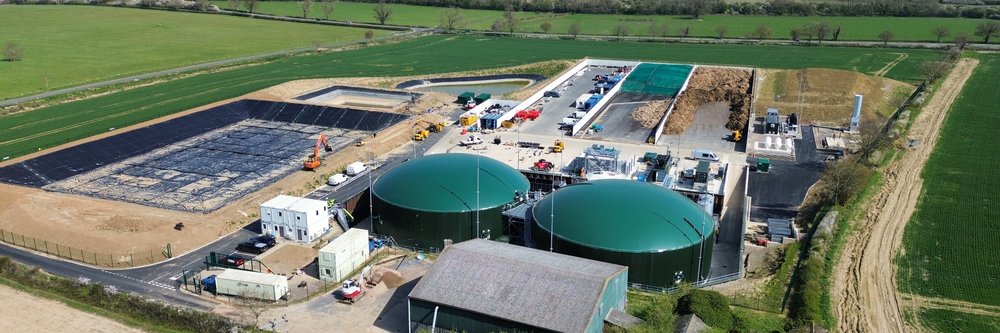
Renewable energy is at the forefront of many farm and estate management considerations. With rising energy costs, pressure to decarbonise and an increasing focus on making land work harder without compromising food production, many rural businesses are exploring alternative income streams. Solar and wind are often the most visible projects, but they are not the only ones.
Another technology is anaerobic digestion (AD). Often hidden from view, operating behind earth bunds and planting schemes, AD plants turn agricultural waste and crops into renewable energy while producing useful byproducts that can benefit local farms and businesses. For landowners and farmers considering diversification, AD offers a way to generate steady long-term income, improve nutrient management and contribute meaningfully to the UK’s net zero ambitions.
A recent visit to a new AD plant south of Market Harborough, Leicestershire offered a valuable insight into how these facilities work in practice, the planning considerations involved and the opportunities they may present for rural businesses.
Turning waste into energy
An AD plant is an industrial facility that breaks down organic material in an oxygen-free environment. Feedstocks can include manure, straw and other agricultural residues, as well as crops such as maize. Inside sealed tanks known as digesters, naturally occurring microorganisms break down this material, producing biogas.
This biogas can be used to generate renewable heat and power or, once upgraded, injected directly into the gas grid as biomethane. What remains after the process, known as digestate, is a nutrient-rich material that can be applied either as a solid or liquid to land as a biofertiliser, reducing reliance on manufactured inputs. AD’s appeal lies in its ability to close the loop. Waste products are turned into energy, nutrients are returned to the land and little, if anything, is left unused.
A long-term vision
The site, based on a family farm, has been developed by CLA member Mark Newton. Mark is a consultant at Fisher German and, more than 25 years ago, was among the first surveyors to specialise in renewables and lead nationally in this fi eld. His journey into AD on this site, however, began elsewhere: originally, the intention was to develop a wind turbine. Planning constraints and local objections made that difficult, prompting Mark to explore alternative renewable technologies. What followed was a 10-year process of research, feasibility work and planning before construction finally began.
The dark green digester tanks look like agricultural buildings, whereas a wind turbine is very visible and a solar park takes up a much bigger area of land
Planning, scale and siting
The plant is located on a 22-acre field, with the operational site itself occupying around 12 acres. The site sits next to a main road, providing easy access from the public highway – allowing feedstocks to be delivered directly to site and avoiding heavy vehicle movements through nearby villages, an issue that concerns local communities.
Planning permission allows the plant to process up to 46,000 tonnes of waste per year. Feedstocks are made up of more than 50% agricultural waste, with the remainder being largely maize. The facility is a 68GW plant and is expected to start up in June, with the first gas entering the grid by mid-July this year.
Several specific conditions were attached to the consent. The digesters’ height was restricted so they could not exceed that of a former grain store already on site. As a result, around six metres of the main digester is sunk into the ground. Another condition required that no excavated material leave the site. Surplus spoil has since been incorporated into bunding, helping to screen the plant from the road.
Partnering with specialists
Rather than the farm operating the plant, Mark – with the help of David Kinnersley, who heads up Fisher German’s AD team– put the site out to tender. The successful operator is VIDA Bioenergy, a Dutch company specialising in biomethane production.
VIDA Bioenergy supports the decarbonisation of buildings, heavy transport and industrial heat, with operations and projects underway in the Netherlands and the UK. This facility is one of its UK projects, complementing another operational site that came online earlier this year.
Partnerships like this can significantly reduce risk. Leasing land to an experienced operator avoids the need for technical expertise while providing a secure income stream during the project’s life.
Managing impact on the landscape
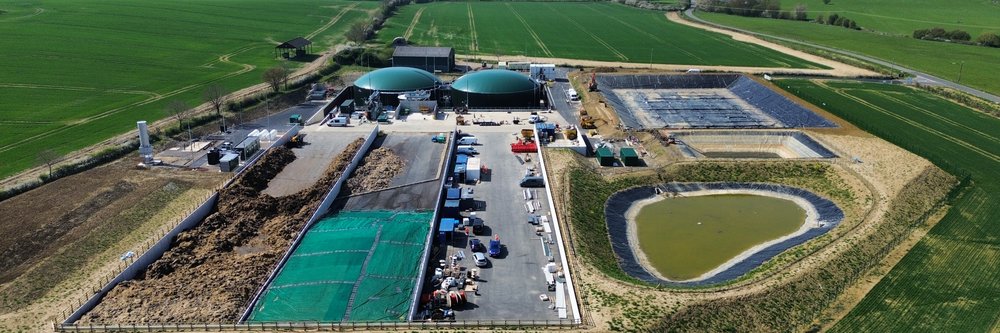
As with any rural industrial development, reducing visual impact is important. This can be difficult during construction, but extensive long-term bunding and landscaping is a condition of the consent.
I think that the great advantage of having an AD plant is that, with good screening, it can be well camouflaged with bunding and tree planting, and blends into the countryside
The bunding will be planted with trees, shrubs and a hydroseed mix to soften views from neighbouring roads and villages, while the digesters themselves are finished in green to help them blend into their surroundings. Seeding is planned for early autumn, coinciding with the first planting season, and the land around the site will continue to be farmed as before.
Inside the process
Once operational, feedstocks (maize, poultry manure and straw) are mixed with water and heated to around 40˚C inside the digesters. This encourages gas production, allowing biogas to rise and be captured. Each digester holds up to 6,000 cubic metres and takes around three weeks to fill.
The digestate is then separated into solid and liquid fractions and provided back to farmers as fertiliser, ensuring nothing goes to waste. The biogas is upgraded to biomethane, with impurities removed and then analysed on site to ensure it meets required quality standards before being injected into the local gas main. A small amount of propane is added to match the energy content of what is already in the main.
Thanks to strong local road links, the operator can easily source material nearby. Some feedstocks, such as straw, are energy-rich but need additional processing, passing through a hammer mill first. When operating at capacity, the plant will generate enough energy to heat around 5,000 homes.
“The other great benefit from AD is that it is ‘circular’, as you put in agricultural crops and waste, this is then turned into green gas, which goes into the grid, making the UK more successful in producing its own green energy,” explains Mark. “The waste from the process is digestate, which can be spread on the land as green fertiliser, saving enormous costs in growing agricultural crops – particularly with current high fertiliser costs.”
Things to consider about AD
So, is AD right for your business?
Anaerobic digestion is not a quick win, nor is it suitable for every holding. Planning complexity, scale, grid connections, feedstock availability and community engagement all play a role. However, for those with the right site and a long-term outlook, AD can offer a resilient, environmentally beneficial diversification option that aligns closely with the future direction of UK renewable energy and agricultural policies.
For rural businesses looking to make sustainability pay, AD is well worth considering. For further advice and information, contact your local CLA office.