Transforming a Yorkshire Dales farm into a diverse rural enterprise
Discover how CLA members, the Leatham family, have converted a 1,100-acre farm in the Yorkshire Dales into a series of thriving rural businesses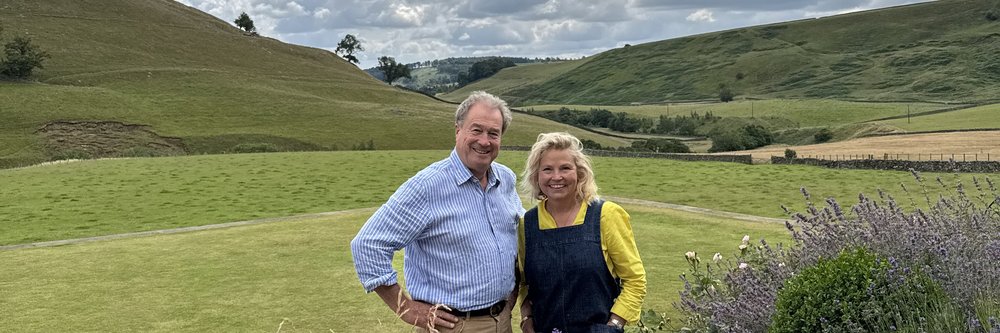
Nestled in a glacial bowl surrounded by moorland in the Yorkshire Dales, the 1,100-acre Telfit Farm offered plenty of opportunities for the Leatham family when they bought it in 2016.
Oliver Leatham, who was familiar with the farm as a visitor on shoot days, jumped at the chance to acquire it when it came up to for sale: “My wife Lucy and I were just blown away by the sheer beauty of the spectacular views on the farm, as well as the dormant potential of the buildings on it.”
Building refurbishments
The couple set about transforming the traditional 19th-century Georgian farmhouse and re-purposing surrounding buildings, including a former milking parlour, dog kennel, barns, toolshed and carthouse.
Today, the farm hosts weddings, where couples get married in the stylishly refurbished former toolshed and have their wedding breakfasts in the converted milking parlour, with the other buildings comprising accommodation. Looking at these spaces now, it is hard to imagine their previous functions.
Renowned landscape garden designer Phillippa May and Yorkshire-based decorator Meg Cunningham helped Lucy and Oliver to design their garden - complete with ha-ha (a sunken wall) - and the buildings’ interiors.
“Lucy and I are very hands-on, and refurbishing the house and surrounding buildings took 11 months, involving 40 people,” Oliver explains. “Planning took longer than anticipated, and we invested a lot of capital to get it ‘just so’, but it was well worth it.”
Telfit offers space for up to 22 guests – 16 in the main house and six in the carthouse – and boasts a sauna, hot tub and firepit. As a luxury retreat, it can host weddings, holiday accommodation, shoots, corporate events, and film and photography shoots. The farm’s grass was used as a prop in the film 28 Years Later, while former Spice Girl Mel B has filmed a documentary there.
Reinvigorating moorland
Telfit owns 75% of the moor’s land, and when Oliver and Lucy bought the farm, they partly fenced it off to regenerate the heather and bilberries. This has benefited grouse and other species such as English partridge, curlew, lapwing, oystercatcher and merlin.
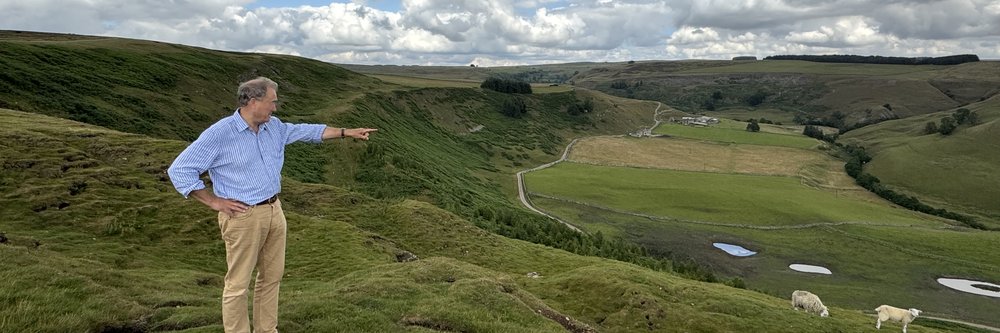
The moorland, which can host up to five shoots per year, has eight tracks, a green lane, a bridleway and public footpaths. A 285m stone wall has been rebuilt, with 800m in scope. The couple plans to get water up to the moor’s fields to benefit the grouse; there is now a trough on every side of it. A large holding tank will be installed, and water pumped up.
Regenerative farming
Two years ago, the couple’s son Ben suggested that the farm employ regenerative practices. “I quite like nature, and have always had an interest in trees,” he says. “I basically wanted to add a bit more interest and premium to our produce and started the regenerative project with our consultant.
“Our habitat restoration projects include planting 350 apple trees in a traditional orchard, establishing wood pastures and meadows, and creating wildlife ponds. We’ve planted 18,000 trees, with plans for 30,000 more, along with 3.5km of native hedgerows, herbal leys across 35ha, and wildflower meadows over 17ha. The hedges divide 34ha into paddocks, which facilitates mob grazing.”
The ambitious planting initiative is supported by the White Rose Forest and Defra’s Nature for Climate Fund, which also includes the creation of seven hectares of riparian woodland and fencing the beck to prevent livestock access.
By improving our soil through natural methods, we can store significant amounts of carbon and increase our farm’s water holding capacity by up to 20,000 litres per acre
“On top of that, we have about 74 Biodiversity Net Gain units as a result of our work.”
A neighbouring farmer manages the farm’s livestock, which include 50 head of Belted Galloway cattle, 40 Middle White pigs and around 200 Herdwick sheep, half the number of the original Swaledale herd. A proportion of the meat finds its way to eatTelfit, Ben’s regenerative meat retail business.
eatTelfit
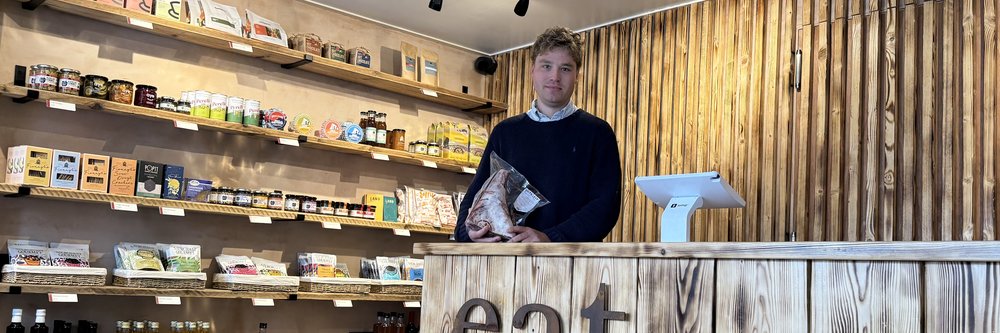
Ben set up eatTelfit just after Covid. “I came from a cheffing background and wanted to add value to the regenerative reared product by utilising every bit of a carcass,” he explains. “We sell everything from bones and fats to broths and stocks, as every part has a value.” Ben sources his meat from eight regenerative farms, largely in the Yorkshire Dales, as well as from Telfit Farm.
I’d rather have fewer farmers with good-quality relationships than spreading it too thinly
“Having fewer farms supplying you with more meat is also beneficial from their perspective.” EatTelfit labels all its meat with its farm origin, breed and age of the animal, as a premium selling point for customers.
“I opened the butchery farm shop, which is also a licenced cutting plant, away from the high street, in Leyburn Business Park, as a cheaper and practical solution - 93% of our sales are online. In the last year, we have sold between five and six tonnes of finished product, excluding turkeys. We work with a high-end turkey producer, selling 80 last Christmas.”
Ben is also considering using the 52 varieties of apple in Telfit Farm’s orchard to make apple cider vinegar. “Eventually, I would like to scale up eatTelfit by gradually growing the business and hopefully bring more regenerative farmers into the fold.”
Visit telfit.co.uk and eattelfit.co.uk to find out more.