Landowners’ guide to wild swimming: what the law really says
Drier weather brings with it more potential wild swimmers, so it’s important for landowners to be aware of their rights and the rights of swimmers. CLA National Access Adviser Claire Wright dives into the detail here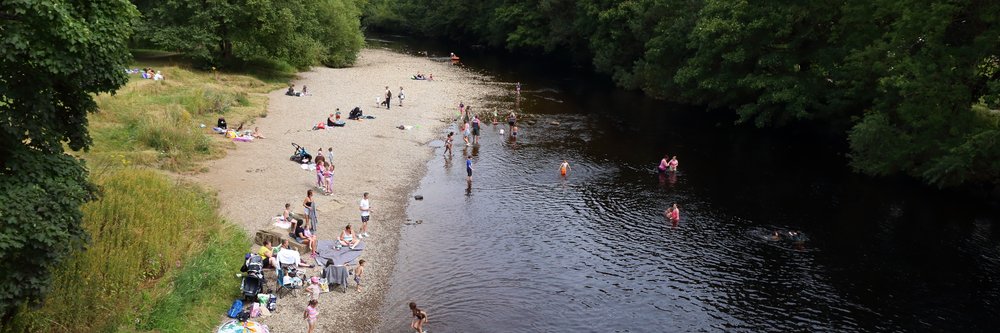
With warnings for heatwaves (issued by the Met Office) becoming a more regular occurrence, there is an increase in the number of people who are likely to visit coastal areas, lakes and rivers - leading to a higher risk of water safety incidents.
This blog explains what land managers need to know about managing risk around water.
Landowner and swimmer rights
There is no general right to swim in non-tidal waters in England and Wales. Therefore, whether someone is permitted to swim in a river or lake largely comes down to the generosity of the landowner.
In general terms the riparian owner of the adjacent land has certain rights over the water and can choose whether to permit swimming or fishing there, and the situation remains the same whether the land is private or public. The swimmer, on the other hand, has no more right to swim in a lake within a municipal country park than they have to swim in the lake of a private landowner.
It is also worth noting that the Countryside & Rights of Way Act 2000 only granted a right for access on foot and did not extend to swimming or the use of paddle craft.
How can landowners protect their interests?
If CLA members have watercourses on their land, then we would recommend erecting suitable signage. Whether the signs are placed for the purpose of highlighting the landowner’s permission or the absence of their permission for swimming to the user of the lake/river/reservoir, both the content and position of the signage will be important.
As a minimum, signs should be legible and visible to the user and should make the position regarding permission or its absence clear to the lay user. You could consider placing these signs by the lake in a visible spot, particularly at known entrance points, you could also put them on your land at known access points or where cars are often parked for their owners to swim.
It’s good practice to remember that the wording should be aimed at the user and informed by the situation. It is also worth noting is that simply setting out ‘private’ or ‘private land’ may be taken to relate to the land adjoining the water not the water itself.
The signage should be photographed in situ with a date recorded, which should happen as a matter of course in the metadata in a digital camera, but if you are relying on printed records, try and ensure the photo has a date recorded on it. It is important to remember that you may be relying on the evidence of the signage years later so keep the image safe.
If you opt to erect signs, then it is imperative that you discuss the exact wording of the sign with your insurance company to ensure that they are content both with the wording and your public liability cover.
Additionally, you should consider the ongoing maintenance of the sign. Noting that it is not uncommon for such signs to be quickly vandalised or removed and also taking further photos in situ when the signs are maintained so you can prove continuity.
Use is likely to be considered to be 'with force' where the user has been made aware of the landowner’s objection. If this is done verbally it should be done calmly and politely and it would then be important to keep a contemporaneous dated, written record of every time this is done, together with notes on the place where the discussion took place and that it was made clear that the swimmer was trespassing.
Land managers should also consider making a statement and deposit under S31 (6) of the Highways Act 1980, setting out that there is no intention to create further public rights of way on the land. This will prevent the build-up of any rights that might give way to successful claims for additional rights of way that could allow the swimmer to access water bodies. You must remember that such declarations do not, however, protect you from claims of historic routes.
Is a landowner liable if someone gets hurt?
Each case turns on its facts, but there has been case law such as in Staples v West Dorset District Council (1995) which held that where a hazard is an obvious danger or risk, a reasonable person in a particular situation would easily perceive, understand and appreciate this. In this case, a high, harbour wall that was covered in wet algae that the landowner did not need to erect signage to warn users of the danger.
It could be argued that the risk of a lake or reservoir containing potentially deep water is obvious. However, the courts generally take the view that there is a greater duty of care for children than adults as their ability to assess risks is less defined.
Section1(5) of the Occupiers Liability Act 1984 provides that in an appropriate case an occupier can discharge the duty they owe to persons other than visitors by taking such steps as are reasonable in all the circumstances of the case to give warnings of the danger concerned or discourage a persons from incurring the risk. Signage should follow the HSE guidelines set out in The Health and Safety (Safety Signs and Signals) Regulations 1996 and should also have a pictorial element rather than simply relying simply on wording.
The leading case on liability around water in such instances is Tomlinson v Congleton Borough Council and another (2003).
The case involved a country park owned and occupied by the first defendant and managed by the second defendant. In this park was a lake that had formed in a disused quarry. It was known to attract many visitors in hot weather. Swimming in the lake was prohibited, and the defendants displayed prominent notices reading "dangerous water: no swimming" and employed rangers with the duty of giving oral warnings against swimming and handing out safety leaflets. The first defendant, aware that the notices were frequently ignored and had little effect in preventing visitors to the park from entering the water and that several accidents had resulted from swimming in the lake, intended planting vegetation around the shore to prevent people from going into the water but had not yet done so because of a shortage of financial resources.
On a hot day the plaintiff, aged 18, went into the lake and from a standing position in shallow water dived and struck his head on the sandy bottom, breaking his neck. He claimed damages against the defendants, alleging that the accident had been caused by their breach of the duty of care that they had owed to him as a trespasser. The courts held that the dangers of diving into shallow water were obvious. Any risk of the plaintiff suffering injury had arisen not from any danger due to the state of the defendants' premises or to things done or omitted to be done on them.
If you as a land manager were to grant permission to a swimmer to access waterbodies in your ownership then this would throw up different responsibilities under the Occupiers’ Liability Act 1957. The swimmer in this situation would be a visitor, the common duty of care is set out at section 2(2):
“The common duty of care is a duty to take such care as in all the circumstances of the case is reasonable to see that the visitor will be reasonably safe in using the premises for the purposes for which he is invited or permitted by the occupier to be there.”
For further advice on this topic, CLA members can reach out to the CLA legal team or download a copy of Managing Safety at Inland Waters from the ROSPA website.
