CLA joins Operation Wolf in the battle against waste crime
Catalogue of offences recorded during initiative on the Hampshire-Thames Valley border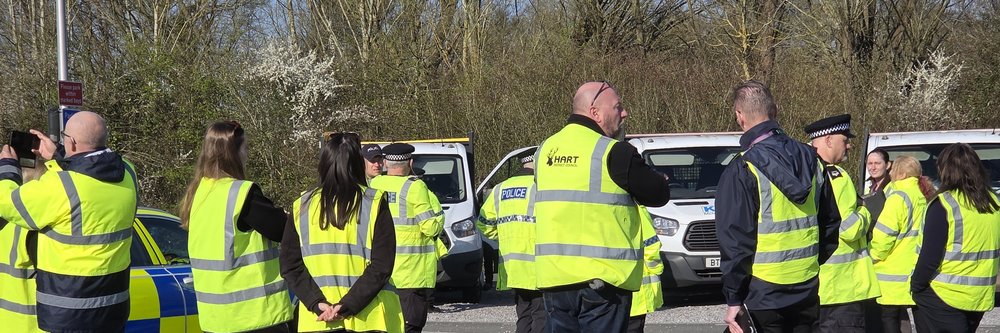
I recently headed out to observe Operation Wolf, a multi‑agency initiative designed not only to identify and disrupt criminal activity, but also to send a clear message to both offenders and the public that the police are actively targeting crime across the south of England.
Waste crime, in particular, remains a low‑risk, high‑reward offence, and operations like this help uncover unlicensed waste carriers who profit from illegal activity—alongside many other offences that inevitably come to light. This was the third such operation in recent months, led jointly by Hampshire Police and Hart District Council.
The operation took place on 19 March at the Mereoak Park and Ride on the A33, right on the Hampshire–Thames Valley border. It proved to be an ideal location: criminals rarely respect borders and often exploit them, assuming enforcement presence will be weaker. The site also offered sufficient hardstanding to safely pull in and process multiple vehicles of any size at once.
From 7am the area quickly became a sea of high‑vis uniforms. Representatives attended from the Environment Agency, Motor Insurance Bureau, Driver and Vehicle Standards Agency, National Highways, DataTag, and enforcement teams from local authorities in Hampshire, Surrey, and Berkshire.
Police support came from Hart and Tadley Neighbourhood Teams, the Commercial Vehicle Unit, Roads Policing, and the Countrywatch Rural Taskforce—all working together to identify, stop, and process drivers and their vehicles.
What happened?
Over the course of the morning, around 40 vehicles were stopped, ranging from small tippers to scaffolding and skip lorries—some of which were too large for the DVSA’s portable weigh scales. Sixteen vehicles were fully compliant: correct documentation, roadworthy condition, and cooperative drivers. Although delayed, many understood and appreciated the purpose of the operation—one legitimate carrier even remarked that they wished these checks happened daily.
However, the operation quickly built up an impressive catalogue of offences. These included a positive drug test and subsequent arrest, a wide range of vehicle defects (tyres, lights, trailer problems), illegal loads, lack of insurance, and waste licence breaches. Local mobile tyre fitters were kept busy, with 10 vehicles unable to leave the site until dangerous tyres had been replaced.
A number of vehicles were found to be overweight, leading to drivers being instructed to offload materials on site and return later. Gravel and soil were redistributed by hand, and one scaffolding lorry had to leave behind at least half its load to comply with legal weight limits, with colleagues later collecting the remainder.
Conversations with local authority representatives highlighted a significant challenge: enforcement teams are often under‑resourced and financially constrained – demonstrated by the fact that despite five authorities being present on the day, not one had ever seized or crushed a vehicle proven to be involved in fly‑tipping.
Everyone involved took something valuable from the day, making new contacts and forming partnerships that will help replicate similar operations across the region. From the CLA’s perspective, it was an invaluable opportunity to understand both the strengths and weaknesses in current efforts to combat rural crime and identify opportunities for improved knowledge sharing.
My own key takeaway was clear: tackling rural crime effectively requires a joined‑up, multi‑agency approach—strong communication, strong leadership, and a willingness to work across borders.
