What does Defra’s Farming and Countryside Programme report tell us about the future of support for farms?
As the CLA’s Anna Novis describes, the latest annual report from Defra reveals a shift from income support in England to environmental and innovation-focused schemes
Defra’s Farming and Countryside Programme annual report for the 2024-25 financial year provides a detailed breakdown of how public funding has been allocated across farming, land management, and rural support schemes in England. The report offers a useful overview of where investment has been directed and what we can expect going forward.
Transitioning away from basic payments
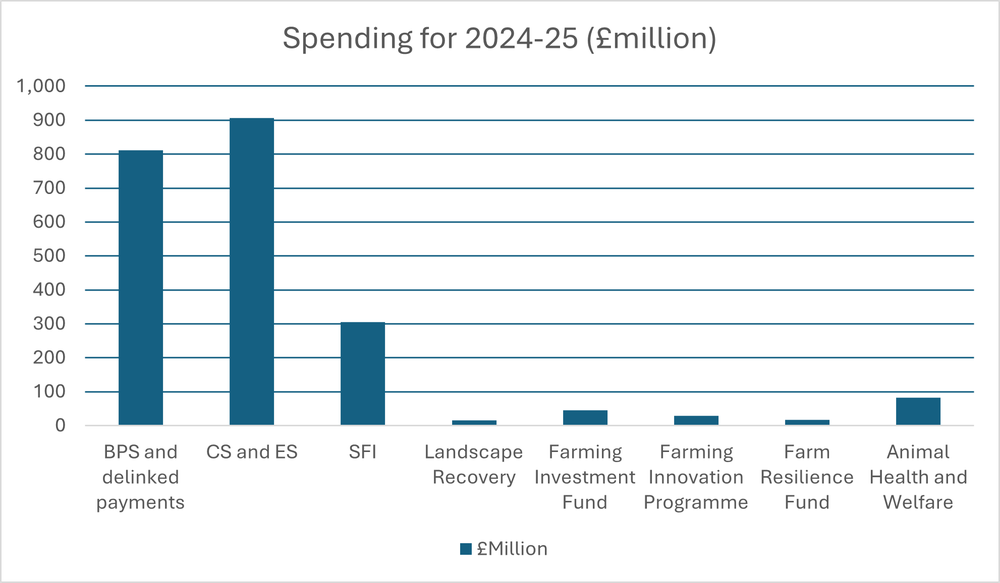
One of the most notable shifts is the continued reduction in Basic Payment Scheme (BPS) funding. The move to delinked payments marks a significant step in the agricultural transition, with £811m paid to approximately 82,000 businesses this year. While this remains a substantial portion of overall funding, the report confirms that these payments are on a declining trajectory (falling further from the £1.87bn prior to the transition). This is in line with the seven-year transition period scaling down BPS, as required under the Agriculture Act 2020.
The expectations of smooth annual reductions in BPS was changed earlier this year when the payment rates for 2026 and 2027 were confirmed, with reference amounts below £30,000 being subject to a 98% cap and 100% reductions for amounts above £30,000. This effectively means that the maximum payments for any business in 2026 and 2027 will be £600.
Environmental Land Management schemes
Environmental scheme spending totalled £1.394bn (increasing from £806m in 2023 to 2024), reflecting the programme’s shift toward rewarding environmental outcomes. Within this:
- Countryside Stewardship and Environmental Stewardship spending amounted to £906m, supporting habitat protection, water quality improvements, and landscape features
- The Sustainable Farming Incentive (SFI) was allocated £305m, with over 39,000 live agreements covering 885,000 hectares of arable land managed without insecticides, 330,000 hectares of low-input grassland managed sustainably and 85,000km of hedgerows protected and restored
- Landscape Recovery spending amounted to £15m, supporting 34 project developments focused on peatland, river, woodland, and habitat restoration
Capital grants under Countryside Stewardship also supported the planting of 1.3m trees, 1,062km of hedges, and 7,638km of sheep netting.
Productivity, innovation and welfare
Funding for productivity and innovation totalled £274m, increased from £136m in 2023 to 2024 (although significantly less than BPS and the Environmental Land Management schemes). This included:
- £45.8m through the Farming Investment Fund
- £29m for the Farming Innovation Programme, including a nutrient management competition
- £17m for the Future Farm Resilience Fund
Animal health and welfare received £83m, with £20m allocated to health and welfare grants and £63m to the Livestock Information Service.
This spending breakdown is reflected in the table below.
Observations
The report confirms that funding is being rebalanced – with a clear shift away from income support toward environmental and strategic investment. The 2025-26 figures will continue this trend, particularly given the cap on BPS at £7,300 this year, with more funding moving towards the Environmental Land Management schemes. The budget for 2025-26 is almost all committed, hence the early closure of the Sustainable Farming Incentive in March, and only invited applications for Countryside Stewardship being accepted.
As we move towards the start of the next three-year spending periods from April 2026 to March 2029, the CLA is engaging with Defra to support the evolution of the programme including the design of new schemes and allocation of funding between programmes.
The significant drop in BPS funding will be felt by farmers and questions remain about the shape of future agri-environmental schemes which may provide some consolation. In particular, we are awaiting an announcement about the details of SFI 2026, including who will have access to it, what it will be available for and the extent of funding available.