Tackling the grey squirrel problem: government releases its long awaited policy statement
An in-depth review of the recent policy statement from Defra and the Forestry Commission on grey squirrels in England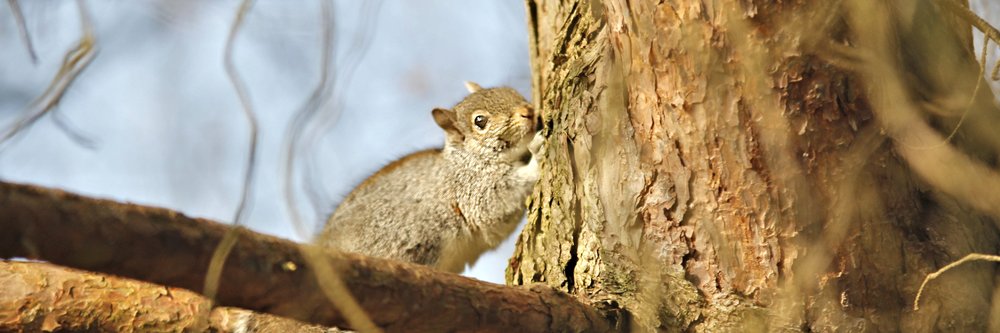
A new grey squirrel policy statement for England has been published by Defra and the Forestry Commission (FC). Many in the forestry sector had, for several years, been awaiting something from the government on the strategy to tackle this invasive non-native species – particularly since a commitment was made to update the 2014 Grey Squirrel Action Plan in HM Government’s 2021 England Trees Action Plan.
An updated strategy has been a long standing CLA ask of Defra. The new policy statement updates and replaces the 2014 plan. It sets out the current approach in England to tackle the environmental and economic threats posed by grey squirrels.
Key points in the grey squirrel policy statement
Defra says that it, and the FC, will play a leading role to:
- Reduce the impact of grey squirrels on England’s trees and woodlands
- Help to protect England’s native red squirrel population
- Provide land managers with funding, advice and training on how to manage grey squirrels
They intend to achieve this work in partnership with the forestry sector, landowners, charities, volunteer groups and researchers to “act as a catalyst for the sector, providing funding and guidance to accelerate action.”
There are many actions outlined in the policy statement which will be progressed over the next five years. These actions are set out under the five themes of:
- Landowner responsibilities and incentives
- Delivering through partnerships
- Research and development
- Communications
- Guidance, training and skills
Some key actions include:
- encouraging landowners to take greater action through financial incentives and advice
- supporting conservation volunteers and landowners, by leading communication on the impacts of grey squirrel and providing support for training in grey squirrel management
- supporting research into novel forms of population management
Damage to trees from grey squirrels and its cost
As most woodland owners know only too well, grey squirrels can severely damage and even kill broadleaf and conifer trees by stripping their bark. Trees can also die as a result of secondary infections where bark has been removed. Along with extreme weather events, browsing from unsustainably high deer populations and a growing array of other tree pest and diseases, the grey squirrel is a key threat to the health and longevity of our woodlands. Broadleaves such as sycamore, beech, birch and oak are particularly susceptible but bark stripping affects at least 40 species including conifers.
This damage comes at a significant cost. The policy statement cites a 2021 Royal Forestry Society (RFS) survey which estimated the cost of grey squirrel damage to trees in England and Wales at around £37m per year in lost timber value, reduced carbon capture, damage mitigation and the cost of trees to replace those damaged or killed by bark stripping. A more recent 2022 estimate by the European Squirrel Initiative charity put the figure at around £60m a year given rising timber prices.
Impact of grey squirrels on native red squirrels
Reduced timber value and quality and suppression of carbon sequestration potential are bad enough but there are other biodiversity costs too. Since the grey squirrel was introduced from North America in the late nineteenth century it has spread all across England and Wales to the detriment of the now endangered native red squirrel. Grey squirrels out-compete native red squirrels for food and spread the squirrel pox virus to them – this is fatal to reds but greys are usually unaffected.
There are estimated to be 2.7m greys across the UK. Reds still dominate in the Scottish Highlands but in England, reds have dwindled to around 39,000. Outside of the far north of England, reds now only exist on the Isle of Wight plus a few isolated pockets in Wales.
Research into long term solutions
Control of grey squirrel numbers relies on trapping and shooting – both labour intensive, costly and often ineffective. As a result, research is being carried out into longer term methods of population control.
There are two key areas – a species-specific, bait administered fertility control vaccine being researched by the Animal and Plant Health Agency (APHA) and a separate area of research into 'gene drive' – a technique where genes are modified to increase their chance of inheritance. Certain traits e.g. infertility can be carried through a population rather than eliminated by natural selection – thereby reducing long term breeding success. Both areas still require several years of research to be funded and completed before resulting in a practical solution which could be rolled out on the ground.
The CLA is a signatory to the UK Squirrel Accord which promotes the APHA fertility control research and brings together many organisations interested in tackling the grey squirrel issue in the UK. CLA also did a joint webinar in 2021 with Confor and the European Squirrel Initiative to promote the gene drive research.
CLA analysis of the grey squirrel policy statement
A policy statement on tackling the grey squirrel issue is overdue and delivers on a long standing CLA ask. There has been a marked lack of substantive government communication on this issue for several years so the policy statement is welcome.
The statement rightly identifies that action is required in both the short-term and the long-term. In the absence of deployable long-term solutions, landowners are reliant on trapping and shooting which as noted above are costly. The most tangible help for woodland owners in England in recent years has been the grey squirrel control and management funding through Countryside Stewardship. The continuation of support like this is essential and it is positive that the policy statement says that financial incentives will remain part of the plan. Requiring grey squirrel issues to be addressed in woodland management plans is also sensible.
Defra continuing to support research into long term solutions to the grey squirrel issue is clearly also welcome. However, more urgency and ambition is needed on this. Is it enough to “continue to support research carried out by APHA into an oral form of fertility control” and “work with research funders to address evidence gaps and encourage funding through their relevant programmes”?
The government is spending close to £1bn on trees during this parliament – the long-term benefits from which are seriously compromised by the lack of an effective long-term solution to the grey squirrel problem. A more ambitious commitment to accelerate the completion of research, product development and regulatory approval is perhaps required given the scale of the grey squirrel problem and the government’s substantial financial commitment to trees.
